Overview of Hemodialysis Mechanism
Hemodialysis is a renal replacement therapy that removes waste products, excess fluids, and toxins from the blood by circulating it through an external filtration system. The effectiveness of hemodialysis is based on well-established physical and chemical principles, primarily diffusion and convection, which occur across a semi-permeable dialysis membrane.
Understanding these mechanisms is essential for optimizing dialysis efficiency and selecting appropriate dialysis products such as dialyzers, dialysate, and blood tubing systems.
Fundamental Principles of Hemodialysis
Concentration Gradient as the Driving Force
The removal of unwanted substances during hemodialysis is driven by a concentration gradient between the patient’s blood and the dialysis fluid (dialysate). Substances naturally move from an area of higher concentration to an area of lower concentration across the dialysis membrane.
By carefully controlling dialysate composition and flow rate, hemodialysis promotes efficient removal of uremic toxins while maintaining essential electrolytes.
Two Main Clearance Mechanisms in Hemodialysis
1. Diffusive Clearance (Dialysis)
Diffusion is the primary mechanism for removing small molecular weight solutes from the blood.
How diffusive clearance works:
-
Small solutes such as urea, creatinine, potassium, and phosphate move across the semi-permeable membrane
-
Movement occurs from blood (higher concentration) to dialysate (lower concentration)
-
The rate of diffusion depends on:
-
Solute size
-
Concentration gradient
-
Membrane permeability
-
Blood and dialysate flow rates
-
Diffusive clearance is particularly effective for removing low-molecular-weight toxins that accumulate in patients with kidney failure.
2. Convective Clearance (Ultrafiltration)
Convection, also known as convective clearance, is based on the principle of ultrafiltration, where water is forced across the dialysis membrane under pressure. As water moves, it carries dissolved solutes with it.
Key features of convective clearance:
-
Driven by transmembrane pressure
-
Removes middle-molecular-weight substances
-
Solutes are transported along with water flow (“solvent drag”)
Convective clearance plays a crucial role in removing inflammatory mediators and larger toxins that are less efficiently cleared by diffusion alone.
Role of Dialysate in Hemodialysis
Composition of Dialysate
Dialysate is a specially formulated fluid designed to facilitate the removal of waste while preserving physiological balance. It typically consists of:
-
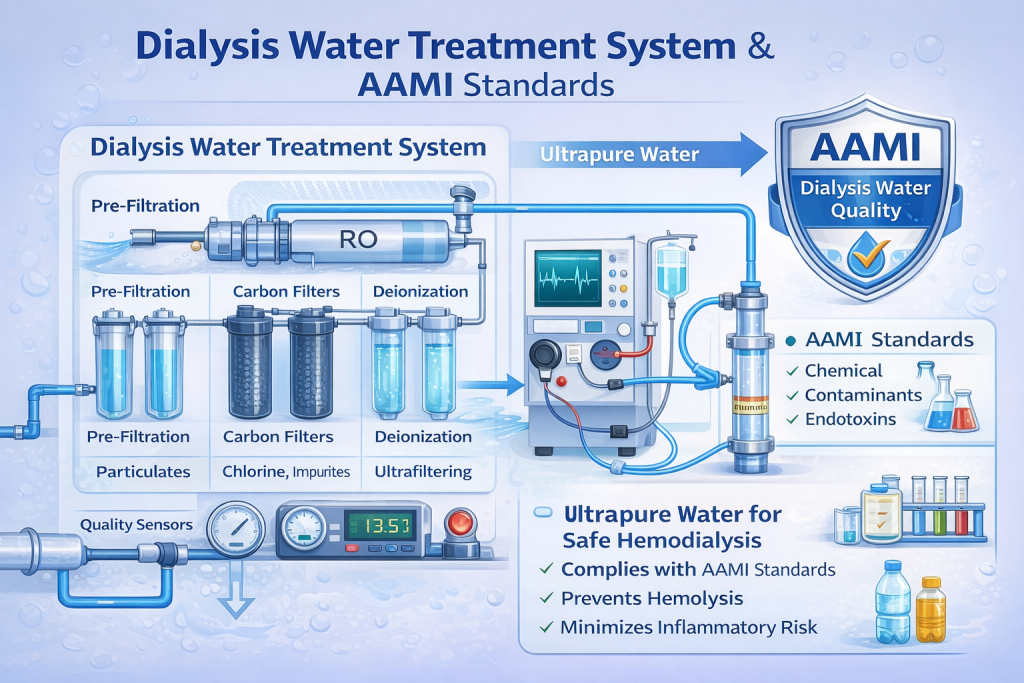
Ultrapure water (the primary component)
-
Electrolytes such as sodium, potassium, calcium, magnesium, and chloride
-
Buffer agents (commonly bicarbonate)
-
Glucose (to maintain osmotic balance)
The composition of dialysate is carefully adjusted to match clinical requirements and ensure patient safety.
Dialysate as a Blood-Cleansing Medium
Dialysate acts as a chemical sink, continuously absorbing waste products from the blood while preventing excessive loss of essential substances. Its controlled composition allows selective removal of toxins without disturbing metabolic stability.
Countercurrent Flow Principle
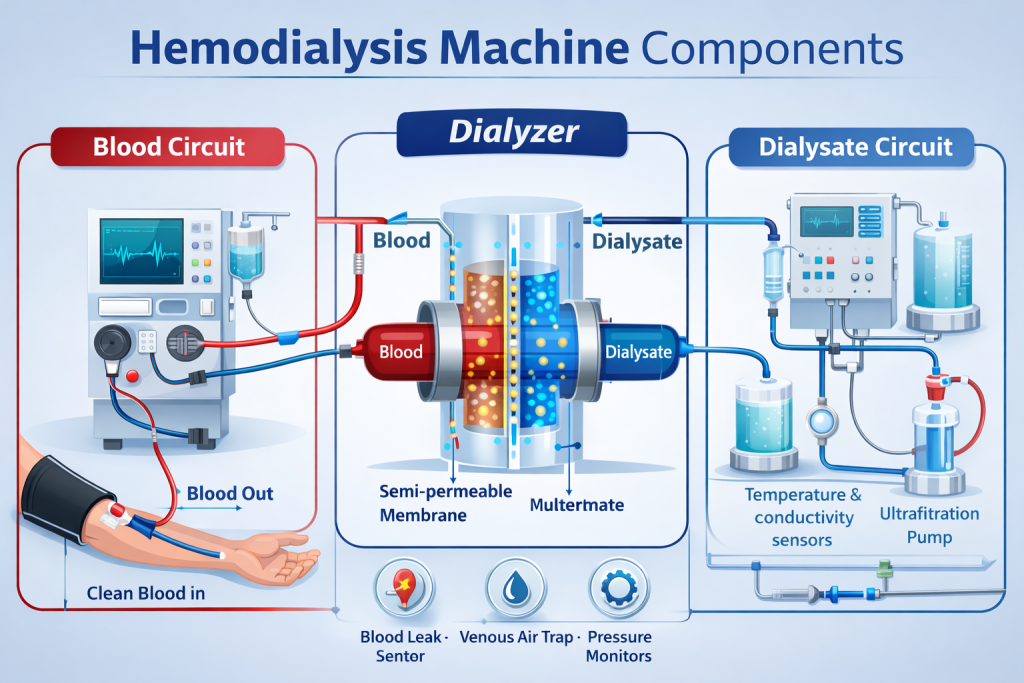
Hemodialysis systems employ a countercurrent flow design, in which:
-
Blood flows through the dialyzer in one direction
-
Dialysate flows in the opposite direction
This countercurrent flow maintains a constant concentration gradient along the entire length of the membrane, significantly enhancing diffusion efficiency and overall dialysis performance.
Key Hemodialysis Components and Product Relevance
Dialyzer (Artificial Kidney)
The dialyzer contains thousands of hollow fibers made of semi-permeable membrane material. It is the core component responsible for diffusion and convection during treatment.
Key characteristics include:
-
Membrane material and surface area
-
Pore size and permeability
-
Biocompatibility
Dialysate Solutions
Dialysate solutions must meet strict standards for chemical composition and microbiological purity. High-quality dialysate is essential for effective toxin removal and patient safety.
Blood Tubing Systems
Blood tubing sets ensure safe and controlled circulation of blood between the patient and the dialysis machine. They are designed to minimize clotting, pressure loss, and contamination during treatment.
Conclusion
Hemodialysis relies on the combined principles of diffusion and convection, driven by concentration gradients and transmembrane pressure across a semi-permeable membrane. The use of ultrapure dialysate, countercurrent flow, and advanced dialysis components enables effective and safe removal of unwanted substances from the blood.
A thorough understanding of these mechanisms supports better clinical outcomes and guides the selection of appropriate hemodialysis products, including dialyzers, dialysate, and blood tubing systems.