Understanding the Hemodialysis System Architecture
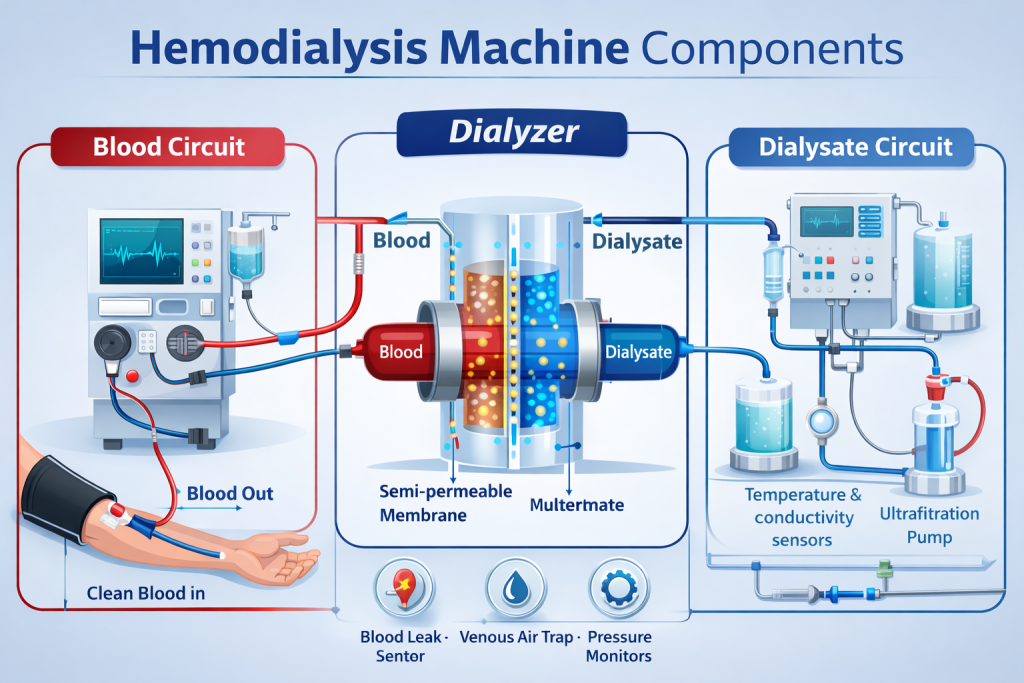
A hemodialysis machine is a sophisticated medical device designed to replace essential kidney functions by removing waste products, excess fluids, and toxins from the blood. Its operation is based on the coordinated interaction of two independent but interconnected systems:
-
Blood circuit
-
Dialysis solution circuit (dialysate circuit)
These two circuits are linked by the dialyzer, where blood purification takes place through a semi-permeable membrane.
The Two Main Circuits of a Hemodialysis System
1. Blood Circuit
The blood circuit is responsible for transporting the patient’s blood from the vascular access to the dialyzer and back to the patient.
Key components include:
-
Arterial and venous blood lines
-
Blood pump
-
Pressure monitors
-
Air trap and air detector
-
Safety clamps
Blood is continuously circulated at a controlled flow rate to ensure efficient toxin removal while maintaining patient safety.
2. Dialysis Solution Circuit
The dialysate circuit delivers dialysis solution to the dialyzer and removes used dialysate after toxin exchange.
Main components include:
-
Dialysate preparation and mixing system
-
Dialysate pump
-
Temperature and conductivity sensors
-
Ultrafiltration control system
The dialysate circuit creates and maintains optimal chemical and physical conditions for effective diffusion and convection during treatment.
The Role of the Dialyzer: The Bridge Between Two Circuits
The dialyzer, often referred to as an “artificial kidney,” serves as the critical interface between the blood circuit and the dialysate circuit.
Key functions of the dialyzer:
-
Separates blood and dialysate while allowing selective exchange
-
Enables diffusion of small solutes
-
Supports convective clearance through ultrafiltration
-
Prevents direct contact between blood and dialysate
At the core of the dialyzer is a semi-permeable membrane, which determines dialysis efficiency and biocompatibility.
Dialysis Membrane Technologies
Regenerated Cellulose Membranes (Hydrophilic)
Regenerated cellulose membranes are naturally hydrophilic, providing:
-
Good biocompatibility
-
Stable diffusion characteristics
-
Long clinical history and proven safety
These membranes are commonly used in conventional hemodialysis applications.
Synthetic Membranes (Polysulfone)
Polysulfone membranes represent advanced synthetic membrane technology and are widely used in modern hemodialysis.
Key advantages include:
-
High permeability
-
Excellent mechanical strength
-
Improved clearance of middle-molecular-weight toxins
-
Enhanced biocompatibility
Polysulfone membranes are suitable for high-flux hemodialysis and advanced dialysis modalities.
Safety Components in Hemodialysis Machines
Patient safety is ensured through multiple integrated monitoring and protection systems, including:
Blood Leak Detector
-
Detects the presence of blood in dialysate
-
Prevents membrane rupture–related complications
Venous Air Trap and Air Detector
-
Removes air bubbles from the blood
-
Prevents air embolism
Pressure Monitoring System
-
Continuously monitors arterial and venous pressures
-
Detects blockages, disconnections, or abnormal flow conditions
These safety features work together to maintain stable and secure dialysis treatment.
Relevant Products and Clinical Applications
This system architecture is directly related to the following products:
-
Hemodialysis machines
-
Dialyzers (dialysis filters)
-
Blood tubing sets
-
Dialysate delivery systems
Proper integration of these components ensures effective dialysis performance and patient safety.
Conclusion
A hemodialysis system consists of two main circuits—the blood circuit and the dialysis solution circuit—connected by a dialyzer containing a semi-permeable membrane. Advanced membrane materials such as regenerated cellulose and polysulfone, combined with comprehensive safety monitoring systems, enable efficient and safe renal replacement therapy.
Understanding the structure of hemodialysis equipment is essential for selecting appropriate devices and optimizing clinical outcomes.